

The Dragon Saucer Plate: Iron-Red and Underglaze Blue Mastery
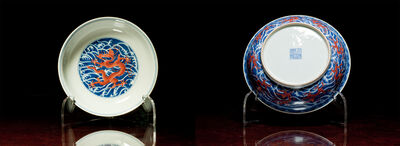
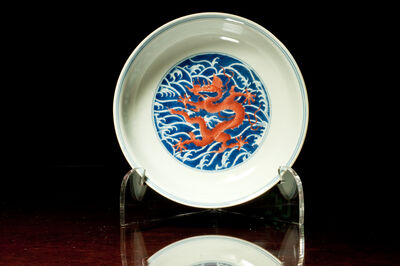
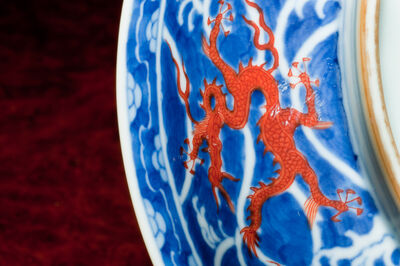
The blue and white iron-red dragon saucer plate represents one of the most sophisticated achievements of Qianlong period porcelain manufacture. The composition demonstrates a masterful command of the demanding double-firing technique, wherein iron oxide pigments are applied to the unfired surface after the blue underglaze has been completed, requiring careful kiln management to prevent the iron-red from bleeding or fading. The front of the plate showcases a commanding five-clawed dragon, its form rendered in brilliant iron-red pigment against a background of stylized blue and white waves that convey the cosmic waters of classical Chinese cosmology.
The reverse side reveals a composition of profound symbolic meaning: nine iron-red dragons interspersed among blue wave patterns. The nine-dragon motif possesses deep significance in imperial Chinese tradition, as the dragon has long embodied imperial authority and celestial power, while the number nine represents the supreme expression of yang, the masculine and active principle in Chinese philosophy. By depicting nine dragons across the reverse, the potter signals the highest order of imperial legitimacy and cosmic harmony. The Qianlong seal mark in zhuanshu, or square seal script, is rendered with precision in blue underglaze pigment, confirming both the imperial workshop of origin and the absolute authority of the Qianlong reign.
Iron-Red and Underglaze Blue: A Demanding Technical Achievement
The combination of iron-red and underglaze blue represents one of the most technically challenging decorative techniques in Chinese porcelain production. The blue underglazes must be applied and allowed to dry fully before the iron-red pigments are introduced, as moisture from fresh blue application would compromise the iron-red's adherence to the biscuit surface. The firing sequence requires precise temperature control within the kiln chamber, as iron-red achieves its distinctive bright hue only within a narrow thermal window—too cool, and the red becomes muddy and dull; too hot, and the pigment disperses into the glaze and loses definition. The iron-red, technically termed hongse (紅色) or specifically jihong (祭紅) when referring to the sacrificial red reserved for imperial temple vessels, demanded exceptional ceramic expertise and yielded pieces of unquestionable prestige and rarity.
The technical mastery evident in this saucer plate speaks to the elevated status of the imperial kilns at Jingdezhen during the Qianlong period. The combination of pigments was not merely decorative but carried profound cultural meaning—blue representing the heavens and water, iron-red symbolizing prosperity and imperial authority. The successful synthesis of these two demanding techniques on a single vessel represents the zenith of ceramic artisanship during the reign of the Qianlong emperor.
Copper-Red Monochromatic Glazes: The Ultimate Challenge
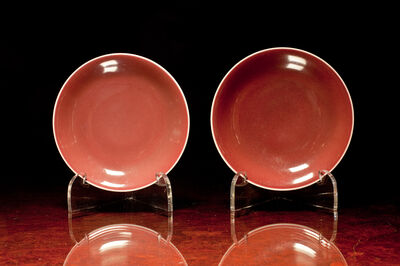
The pair of monochromatic copper-red glazed dishes, each with a diameter of 13.8 centimeters and bearing the Qianlong reign mark in seal script, exemplifies one of the most challenging and prized glaze techniques in the history of Chinese ceramics. The copper-red glaze, when successfully fired, yields a luminous, deep scarlet hue of remarkable beauty and rarity. However, the technical obstacles to achieving such a glaze are formidable: copper oxide requires an exceptionally reducing atmosphere within the kiln to achieve its red coloration, yet this same reducing environment must be carefully balanced against the competing demands of the porcelain body and other glaze components. A slight deviation in kiln temperature, oxygen levels, or atmospheric composition can result in complete failure, producing gray, mottled, or disappointingly brown surfaces instead of the desired scarlet.
The sustained success rate during the Qianlong period was remarkably high compared to earlier dynasties, reflecting both technological advancement and the considerable resources available to the imperial workshops. The white glazed rims on these copper-red dishes serve a dual function: they provide a visual frame that enhances the purity of the monochromatic field, and they serve a technical purpose, as the white underglaze functions as a buffer zone that prevents copper oxide migration to the vessel's edge. The presence of the Qianlong reign mark in seal script confirms imperial workshop production, making these objects of exceptional significance and desirability to collectors of Chinese ceramics. Copper-red glazed pieces command extraordinary prices in the contemporary market, and pairs such as these are rarer still, as many such vessels were separated over centuries of transmission.
The Symbolism and Rarity of Copper-Red Monochromes
The monochromatic copper-red glaze held profound symbolic significance in the imperial context. Red has long represented prosperity, happiness, and imperial authority in Chinese tradition, making copper-red glazed vessels particularly suitable for imperial use and display. The difficulty in achieving successful copper-red glazes meant that pieces bearing this finish were immediately recognized as products of imperial workshops with access to superior materials, technical expertise, and the financial resources to absorb inevitable failures during production. During the Qianlong reign, the imperial kilns achieved unprecedented success with copper-red glazes, producing pieces of extraordinary beauty and consistency that were prized within the imperial collection and gifted as honors to favored officials and allied rulers.
Sang de Boeuf and Copper-Red Glazes: The French Term and Chinese Origins
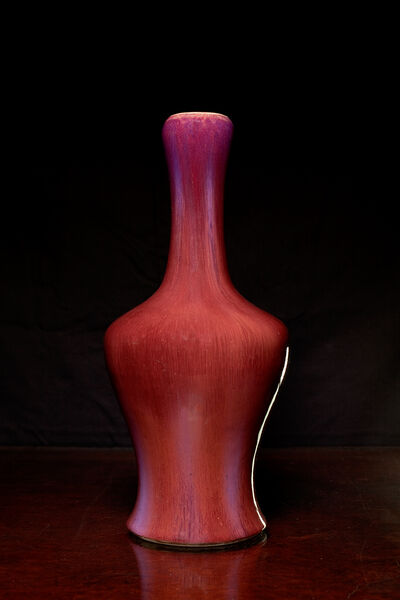
The sang de boeuf bottle vase exemplifies the pinnacle of copper-red glaze achievement in eighteenth-century Qing ceramics. The French term "sang de boeuf," meaning "ox blood," emerged during the nineteenth-century European connoisseurship of Chinese ceramics and reflects the wine-dark, deep crimson hue that characterizes this glaze type. However, the technique originated in Chinese ceramic tradition and carries profound significance within the imperial aesthetic. The Chinese names for this glaze variety include jihong (祭紅), meaning "sacrificial red," a term reserved for the deepest, most vibrant copper-red glazes used in imperial ritual vessels, and langyao hong (郎窯紅), the "Lang Kiln red," named after the legendary ceramic master Lang Tingji who perfected the technique during the Kangxi reign (1661–1722). The continuation of this glaze tradition through the Yongzheng and Qianlong reigns represents an unbroken lineage of technical mastery spanning generations of imperial ceramic specialists.
Technical Mastery: The Art of Copper-Red Reduction Glazing
The production of sang de boeuf glazes demands extraordinary technical skill and intimate knowledge of kiln chemistry. The colorant derives from copper oxide, which under normal oxidizing conditions produces a green or blue glaze. However, within a reducing atmosphere—an environment deliberately deprived of oxygen—the copper oxide transforms into copper(I) oxide, producing the characteristic deep red coloration. This transformation occurs only within an extremely narrow temperature and atmospheric window, typically between 1200 and 1300 degrees Celsius, with precise control of oxygen depletion being essential. A slight miscalculation in kiln management transforms what would have been a spectacular scarlet glaze into a muddy brown or gray surface, representing complete technical failure and economic loss.
Beyond the glaze chemistry, the aesthetic refinement of sang de boeuf vessels lies in the characteristic surface effects that emerge from successful reduction firing. The distinctive "ox-hair" streaking effect, known as niumaosi (牛毛絲), creates delicate linear patterns across the glaze surface, resembling the fine hairs of an animal's coat. These streaks form when subtle variations in glaze thickness and atmospheric conditions during firing create micro-gradations in the copper reduction, producing streaks of darker and lighter red that animate the otherwise monochromatic surface with visual complexity and depth. The "lamp-wick" rim, termed dengcao kou (燈草口), represents another hallmark of successful copper-red glaze vessels. This feature occurs where the glaze becomes extremely thin at the rim's edge, often due to deliberate application technique or the natural movement of glaze toward the vessel's center during high-temperature firing. At the thinner rim edge, the glaze transitions toward white or pale pink, creating a contrasting frame that visually enhances the deeper scarlet of the main field and provides technical evidence of the kiln master's skill in achieving this demanding effect.
Historical Development: From Yuan Dynasty Origins to Kangxi Perfection
The history of copper-red glazing spans nearly three centuries of Chinese ceramic innovation. The technique originated during the Yuan Dynasty (1271–1368), when early ceramic specialists first experimented with copper oxide reduction glazes. However, these early attempts achieved inconsistent results, with success rates remaining frustratingly low and many pieces emerging from the kiln displaying muddy brown or failed coloration rather than the desired red. The technique languished during the early Ming Dynasty, as potters struggled to maintain consistent production of successful pieces.
The dramatic renaissance of copper-red glazing occurred during the Kangxi reign (1661–1722) of the Qing Dynasty, under the direction of Lang Tingji, an exceptional ceramic master who gained imperial patronage for his expertise. Lang Tingji's innovations in kiln atmosphere control, glaze composition, and firing technique dramatically improved the success rate of copper-red glaze production, transforming the technique from a problematic experiment into a reliable method that consistently produced vessels of extraordinary beauty. The imperial recognition of Lang Tingji's achievements granted him high status and resources, establishing a lineage of knowledge that would be transmitted to subsequent generations of imperial ceramic specialists. The Yongzheng reign (1722–1735) inherited this technical mastery and continued producing remarkable copper-red vessels, and the Qianlong reign (1736–1795) sustained this legacy, creating sang de boeuf pieces that represent the absolute zenith of the technique's eighteenth-century expression. The combination of technical perfection, imperial patronage, and artistic refinement during the Qianlong period established standards of excellence that have never been surpassed in the subsequent history of Chinese ceramics.
The Bottle Vase Form: Elegance and Imperial Aesthetics
The bottle vase, with its elegant elongated neck rising from a generous rounded body, represents one of the most refined vessel forms in Chinese ceramic tradition. The form itself dates to ancient Chinese ceramics, where narrow-necked vessels served practical purposes for storing precious liquids such as wine or ritual oils. However, during the imperial periods of the Qing Dynasty, the bottle vase evolved into a primarily decorative object, designed to be displayed upon fine wooden stands within imperial palaces and the residences of elite collectors. The proportions of this particular sang de boeuf bottle vase exemplify the classical ideal: the body possesses ample volume and subtle curvature that catches and reflects light across the monochromatic glaze surface, while the elongated neck provides elegant visual extension and creates a sense of refined restraint that prevents the form from becoming heavy or crude.
The bottle vase form proved particularly well-suited to copper-red glazing because the shape's continuous curved surface allows the glaze to develop its characteristic color and surface effects without interruption. Unlike dishes or plates, where the glaze must perform across a flat surface vulnerable to uneven color distribution, the bottle vase's three-dimensional form creates subtle variations in glaze thickness and light reflection that enhance the visual complexity of the monochromatic surface. The narrow neck demonstrates the potter's control over form and proportion, while the transition from neck to body—executed with precise curves and careful proportion—represents a fundamental aesthetic achievement of Qianlong period ceramicists. Each successfully fired sang de boeuf bottle vase stands as testimony to the extraordinary technical mastery and refined aesthetic sensibility that defined the imperial ceramic workshops at their absolute zenith.
Imperial Workshop Production and the Unification of Copper-Red Techniques
The three object types discussed in this essay—the iron-red dragon saucer plate, the copper-red glazed dishes, and the sang de boeuf bottle vase—represent distinct yet interconnected expressions of the imperial kiln's mastery of red-based decoration and glaze techniques. While the iron-red dragon plate employs hand-painted iron oxide pigments applied over underglaze blue, and the copper-red dishes and sang de boeuf vase utilize high-temperature reduction glazing, all three represent the Qianlong imperial workshops' preoccupation with achieving the most sophisticated and technically challenging red-based finishes available to ceramic artists. The prevalence of red-based techniques across multiple object types and decorative approaches during the Qianlong period reflects the profound cultural significance of red in imperial Chinese aesthetics, where the color symbolizes prosperity, happiness, imperial authority, and cosmic harmony.
Each of these three object types bears unambiguous evidence of imperial workshop production through reign marks rendered in zhuanshu (seal script) and through the presence of sophisticated technical innovations that place these vessels within the strictest imperial canon. During the Qianlong reign (1736–1795), the imperial kilns at Jingdezhen operated at peak efficiency and creativity, producing ceramics that established standards of excellence unsurpassed in subsequent Chinese history. These objects represent not merely fine examples of decorative arts but rather embodiments of imperial vision, technical mastery, and the immense resources deployed by one of history's greatest collectors and patrons. The convergence of artistic innovation, technical achievement, and imperial patronage during the Qianlong period created a moment of extraordinary ceramic production that collectors and connoisseurs continue to recognize as representing the apex of Chinese porcelain manufacture. For more information on related ceramics from this period, visitors are encouraged to explore our pages on Blue & White, Famille Rose, and Imperial Yellow porcelain traditions.