
Ding Ware: The Song Dynasty's Ivory-White Treasure
Ding ware (定窯, Dingware) holds a distinguished position among the Five Great Kilns of the Song Dynasty (960–1279), a classification that underscores its status in the ceramic hierarchy of medieval China. Produced in Dingzhou (定州), Hebei Province, in northern China, Ding kilns manufactured some of the finest white-glazed porcelain ever created. The ivory-white glaze characteristic of Ding ware represents an extraordinary technical achievement; the thick, glossy surfaces often exhibit the distinctive "tear-drop" glaze pooling that occurs where molten glaze accumulates in deeper recesses of the vessel. This aesthetic feature became one of the most prized qualities of the ware, celebrated by collectors and literati across subsequent dynasties.
The significance of Ding ware lay not merely in its aesthetic refinement but in its accessibility and widespread popularity during the Song period. Unlike the imperial Ru ware, which was reserved exclusively for court use, Ding porcelain found its way into the hands of educated gentry, merchants, and collectors throughout China. This broader circulation ensured that Ding ware's influence extended far beyond the imperial household, shaping the tastes and expectations of Chinese ceramic connoisseurs for centuries to come. The ware's elegant simplicity and technical perfection made it a standard against which other Song ceramics were measured.
Carved Decoration and Archaic References
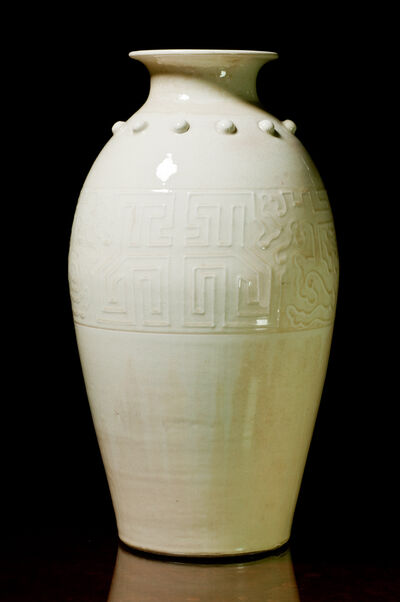
The vase illustrated here exemplifies the refined use of carved decoration (劃花, huahua), a technique in which designs are incised or carved into the clay body before glazing, creating subtle linear patterns that catch light and reveal the porcelain body beneath the glaze. This particular piece bears raised bosses around the shoulder—nipple-like protrusions arranged in regular patterns—alongside bands of intricately carved archaic dragon motifs and leiwen (雷文, geometric key-fret) patterns. These designs draw from ancient bronze vessel aesthetics, reflecting the Song literati's profound reverence for antiquity and their belief in the spiritual and aesthetic authority of archaic forms.
The archaic dragons depicted on this vase are stylized and simplified renderings of the taotie-like patterns found on ritual bronze vessels from the Shang and Zhou dynasties. By incorporating such motifs into Song ceramics, artisans and their patrons demonstrated intellectual engagement with China's remote past, asserting connections to an imagined golden age of craftsmanship and moral rectitude. The repetitive geometric borders and stylized dragons served not only decorative functions but also functioned as visual texts, readable by the educated elite as signifiers of refinement, learning, and ethical cultivation. This practice of antiquarian reference became increasingly important during the Song period, particularly among scholar-officials who sought to distinguish themselves through connoisseurship.
Technical Mastery and Glaze Characteristics
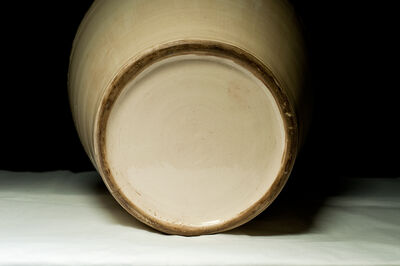
The technical challenges involved in producing Ding ware should not be underestimated. The ivory-white glaze required precise control over firing temperatures, mineral composition, and kiln atmosphere. The thick glaze pooling visible on many Ding pieces resulted from careful experimentation and knowledge of glaze behavior at high temperatures. Notably, examination of the unglazed foot visible at the base of this vase reveals the brownish-buff exposed body characteristic of Ding ceramics—a feature that actually aided identification and became a hallmark of authenticity. The contrast between the white glaze on the body and the bare clay foot provides insight into the kiln technology and glazing practices of Song artisans, who deliberately left certain areas unglazed to prevent vessels from sticking to kiln supports during firing.
The carved decoration technique further demonstrates the exceptional skill of Ding potters. Creating precise, controlled incisions in leather-hard clay required both artistic vision and technical control; too deep and the piece would be weakened, too shallow and the decoration would disappear beneath the glaze. The potter's hand is evident in the varying depth and width of the carved lines, subtle variations that modern analysis has attributed to the work of individual craftsmen or workshops. Such technical proficiency was not accidental but rather the result of generations of accumulated knowledge, passed down through apprenticeship within the Ding kilns.
The Vase Form and Bronze Vessel Traditions
The shape of this vase represents another layer of antiquarian engagement. Song potters deliberately recreated vessel forms derived from ancient bronze bronzes, a practice called "archaism" that pervaded literati aesthetic philosophy. The cylindrical or slightly bulbous body, prominent shoulder, and proportional narrowing toward the neck echo the profiles of ritual vessels from centuries past. By rendering such forms in porcelain rather than bronze, Song craftsmen transformed the meaning and context of these shapes; what had once been implements of ritual and power became objects of aesthetic contemplation and collection.
This formal continuity with antiquity, combined with the carved decoration referencing archaic artistic traditions, creates a unified artistic statement. The vase addresses itself to viewers educated in classical Chinese aesthetics and history, inviting them to read the vessel as a bridge between the Song present and a revered, idealized past. Such objects functioned within elite collecting circles as vehicles for self-cultivation and intellectual refinement, visible expressions of the owner's learning and moral sensibility. The vase thus participates in a broader Song literati project of aesthetic revivalism and historical consciousness.
Ding Ware Within the Five Great Kilns
When considering Ding ware in relation to its contemporaries among the Five Great Kilns—Ru (汝), Guan (官), Ge (哥), and Jun (鈞)—a complex hierarchy emerges. Ru ware, with its distinctive crackled glaze and imperial provenance, occupied the highest aesthetic realm. Guan ware, also court-affiliated, possessed an austere elegance. Ge ware's fractured glaze surface created a unique visual effect. Jun ware's purple-splashed surfaces demonstrated technical audacity. Yet Ding ware, with its refined white glaze and restrained decoration, offered a different kind of excellence: disciplined, elegant, intellectually engaged. For many collectors, particularly during the Ming and Qing dynasties when appreciation for Song ceramics reached its zenith, Ding ware represented the apex of ceramic refinement, the perfect marriage of technical perfection and aesthetic subtlety.
The comparative study of these five kilns reveals Song Dynasty potters working within a complex visual and philosophical landscape. While each kiln developed distinctive glazes and forms, all shared certain aesthetic principles: simplicity as sophistication, restraint as eloquence, and the belief that the most powerful beauty emerged from technical mastery combined with intellectual purpose. Ding ware's position within this constellation speaks to its enduring influence on ceramic traditions, a influence that extended beyond Song borders to shape Japanese aesthetics and ultimately, global understandings of ceramic art.
Collecting Traditions and Later Appreciation
The surviving examples of Ding ware, particularly pieces with carved or moulded decoration such as this vase, represent a small percentage of Song Dynasty production. Most Ding vessels were utilitarian wares—bowls, dishes, and saucers used in everyday or ritual contexts. The elaborate decorated examples that survive were clearly special commissions, perhaps created for official gifts, elite collectors, or temple use. The fact that such pieces were preserved through centuries of political upheaval, warfare, and social change testifies to their perceived value and the esteem in which they were held. Collectors and connoisseurs across the Ming (1368–1644) and Qing (1644–1912) dynasties actively sought Ding ceramics, incorporating them into imperial collections and private assemblies.
Later Chinese scholars and collectors developed sophisticated frameworks for understanding and evaluating Ding ware. Historical texts such as the Ge gu yao lun (格古要論, "Essential Criteria for Antiquities") documented the characteristics of authentic Ding pieces, establishing standards that collectors used to authenticate and value examples. The carved and moulded decoration of this vase would have been particularly valued by such connoisseurs, as it represented the peak of Ding technical achievement and connected the piece visibly to the broader literati aesthetic project of referencing antiquity. In contemporary collecting, Ding ware continues to command respect and admiration, with collectors recognizing in these vessels the refined sensibility and technical excellence that made Song Dynasty ceramics legendary throughout the world.