
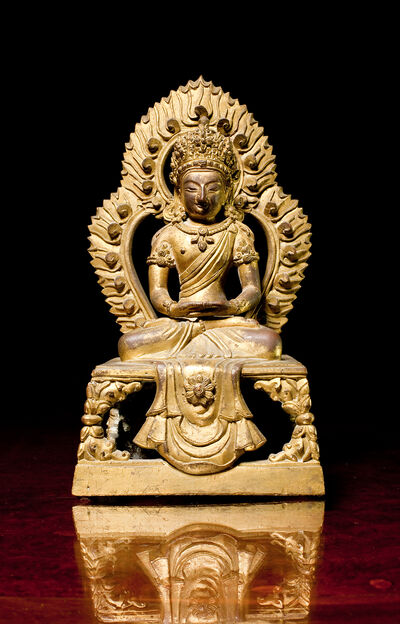
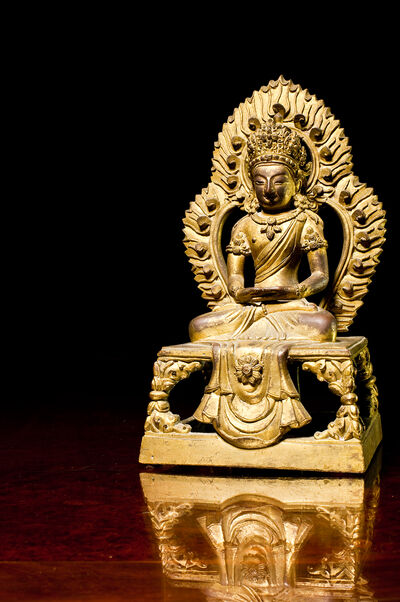
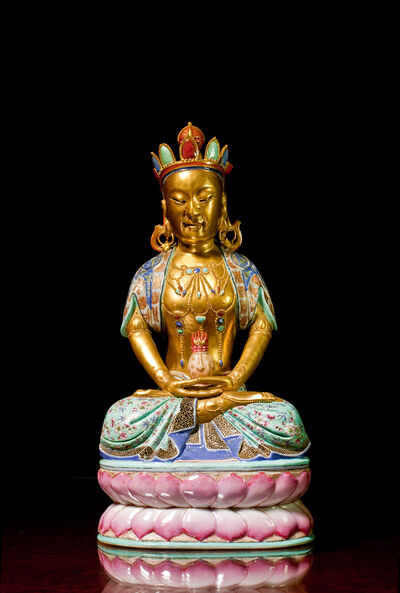
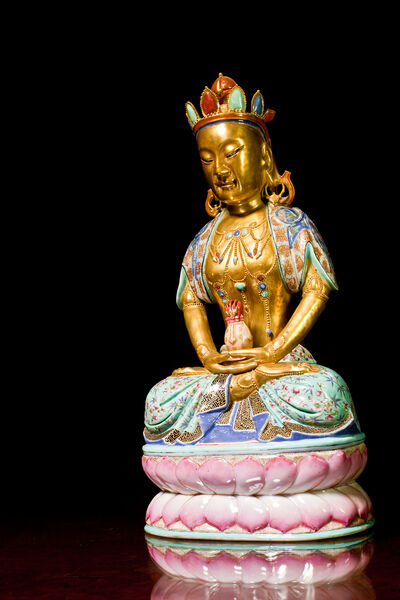
Among the many forms of spiritual expression that emerged from the encounter between Han Chinese civilization and Tibetan Buddhist tradition during the Qing Dynasty, none reveals the conjunction of empire, craft, and faith more eloquently than the sculptural representation of Amitayus — the Buddha of Infinite Life. The two objects illustrated here — a gilt bronze figure of exquisite refinement from the Qianlong period, crowned with a removable mandorla, and a colourful famille rose porcelain rendering from the nineteenth century — represent distinct moments in the long evolution of Himalayan Buddhist devotional art as it took root in the imperial workshops of Beijing and the porcelain kilns of Jingdezhen. To examine these works is to trace the aesthetic and technical achievements of Chinese artisans engaged in the service of a faith tradition that was, for the Qing court, simultaneously a means of legitimizing imperial rule over the diverse peoples of Central and Inner Asia.
Amitayus and the Infinite Buddha: Iconography and Tradition
Amitayus (Tib. Tsepagme, 无量寿佛) represents a distinct manifestation within the complex iconography of Mahayana Buddhism. While often conflated in Western scholarship with Amitabha Buddha — the Buddha of the Western Pure Land, who presides over a realm of bliss accessible to all sentient beings — Amitayus occupies a more specialized position in the tantric Buddhist traditions of Tibet and Mongolia. Amitayus is specifically the Buddha of Infinite Life, and his worship centres upon the attainment of longevity and the perpetuation of the dharma across aeons of time. The god is typically depicted in peaceful form, seated in meditation (dhyana mudra), his hands folded in his lap in the gesture that symbolizes the turning of the wheel of doctrine.
The cult of Amitayus gained particular prominence in the Gelug (dge lugs) tradition of Tibetan Buddhism, the school to which the Dalai Lama belongs. The deity appears frequently in the ritual mandalas and meditation practices of Gelug monasticism, and his image adorned the personal chapels of high-ranking lamas and, indeed, the imperial household itself. The presence of Amitayus figures in Qing imperial collections thus reflects far more than aesthetic appreciation; it constitutes a theological and political statement. By venerating Amitayus, the Qianlong Emperor positioned himself not merely as a patron of Buddhism but as an embodiment of enlightened sovereignty — a ruler who had attained wisdom and commanded vast territories through the benevolence and cosmic influence of Buddhist teaching.
The standard iconographic attributes of Amitayus are consistent across all representations: he wears a five-leaf crown (similar to that of Avalokiteshvara, the Bodhisattva of Compassion), often jeweled or gilded; elaborate necklaces and earrings of precious materials indicate his status as a celestial buddha; and his robes, whether rendered in bronze or porcelain, drape in the manner of the Indian pravrtti — that is, with one shoulder bared, following the conventions of ascetic dress. In the finest representations, including both objects under consideration here, Amitayus is depicted holding a vase of the elixir of life (amrta) in his hands, symbolizing his power to bestow longevity upon his devotees.
The Gilt Bronze Amitayus: Lost-Wax Casting and Imperial Patronage
The seated Amitayus figure from the Qianlong period represents the apex of the imperial bronze foundries' achievement. Measuring 17.8 centimetres in height, this piece exemplifies the superb technical mastery and lavish investment that the Qing court devoted to Buddhist devotional sculpture during the reign of the Qianlong Emperor (r. 1735–1796). The figure is executed in gilt bronze using the cire perdue (lost-wax) method, a technique of extraordinary complexity that allows for the creation of forms of stunning finesse and precision.
The Amitayus sits in complete repose upon a rectangular throne or pedestal base, his hands folded in dhyana mudra, palms upward, resting upon his lap in the gesture of meditative absorption. The face, framed by an elaborate crown, displays the serene, inward-focused expression characteristic of Buddhist iconography — eyes slightly downcast, lips curving in a barely perceptible smile that conveys spiritual tranquility rather than human emotion. The workmanship is extraordinary: individual strands of hair beneath the crown have been rendered with calligraphic delicacy, the facial features exhibit perfect proportions, and the overall demeanour communicates a sense of profound repose.
Most strikingly, this Amitayus is accompanied by a removable mandorla — that is, the flame-shaped or aureole-like halo that surrounds the body of enlightened beings in Buddhist iconography. This mandorla was cast separately and could be affixed to the back of the figure, presumably for ritual purposes. The mandorla itself is a marvel of technical achievement: its surface is intricately pierced and carved in high relief with images of smaller deities and auspicious symbols — a microcosm of the Buddhist cosmos arrayed around the central figure of Amitayus. The flame patterns that define the mandorla's edge suggest the transcendent brilliance emanating from the Buddha's enlightenment.
The gilt bronze casting technique demands exceptional skill and requires the artist to anticipate all possible complications before the original wax model is destroyed. The Qianlong imperial workshops, located in the Forbidden City and directly overseen by the emperor himself, employed the finest craftsmen in China — many of them recruited from the regions of Tibet and Mongolia that fell within the Qing sphere of influence. The presence of Amitayus figures in Qing imperial collections is intimately connected to the emperor's strategy of cultural and religious hegemony; by commissioning these objects in the styles and materials most valued by Tibetan Buddhist culture, the court demonstrated its understanding of, and commitment to, the aesthetic and spiritual values of Central Asian elites.
Technique and Materials: The Challenge of Bronze and Gilt
The gilding of bronze objects in China represents one of the most refined technical achievements of the decorative arts tradition. During the Qing Dynasty, bronze gilding was typically accomplished through the application of mercury amalgam — a process that involved creating a paste of powdered gold mixed with mercury, brushing it onto the surface of the bronze object, and then heating the piece to drive off the mercury, leaving behind a permanent layer of gold burnished and fused to the bronze surface. This fire gilding technique (huojin, 火金) produces a rich, warm lustre that is immediately distinguishable from modern mechanical gilding.
The bronze itself was cast from an alloy typically composed of copper, tin, and a small percentage of lead, the proportions calibrated to produce an alloy of suitable fluidity for the lost-wax process while maintaining the structural integrity of the finished object. The density and colour of the bronze forms a subtle backdrop to the gilt surface: where wear or deliberate patination has removed the gold leaf, the underlying bronze reveals itself in warm reddish or greenish tones that attest to the age and authenticity of the piece.
For such a prestigious imperial commission, the lost-wax mould would have been carved from clay, wax carefully applied and shaped into the desired form, and then the entire assembly encased in a fire-resistant shell mould. The wax is burned away in a kiln, leaving a negative cavity that receives the molten bronze. The finished cast is then carefully chased — that is, refined and articulated through hand-working with small chisels and burins — before gilding and final assembly. For complex works like this Amitayus with its separate mandorla, the component pieces would be cast separately, then fitted together using carefully calculated mortise-and-tenon joinery, often reinforced by bronze rivets concealed with utmost care.
Famille Rose Porcelain and the Democratization of Buddhist Imagery
Whereas the imperial gilt bronze figure of Amitayus represents the pinnacle of court-sponsored Buddhist art, the famille rose porcelain figure of the nineteenth century embodies a different but equally important phenomenon: the adoption of Buddhist iconography by the merchant class and the literati of the Jiangnan region — the region of the Yangtze River Delta comprising Jiangsu, Zhejiang, and Anhui provinces. This porcelain Amitayus, with its gold-gilt face and hands and its robes rendered in the brilliant overglaze enamels characteristic of the famille rose palette, speaks to a broader diffusion of Buddhist devotional imagery throughout Chinese society during the Qing Dynasty and beyond.
The figure is cast in white porcelain and seated upon a pink lotus petal base — the lotus being the primary symbol of Buddhist purity and enlightenment, said to grow immaculate from muddy waters, just as the Buddha achieves enlightenment while remaining uncontaminated by the suffering of the world. The face and hands are covered in gold leaf, applied with the same meticulous care as the gilt bronze figures of the imperial workshops, but here the technique is employed on the surface of fired porcelain rather than on cast bronze. The elaborate crown is rendered in overglaze enamels, with individual stones or jewels suggested through touches of colour — primarily blues, reds, and greens — applied with a fineness of touch that required great skill and considerable experience.
Most characteristic of this piece is the treatment of Amitayus's robes. Rather than the austere, unadorned drapery of the gilt bronze figure, the robes here burst forth with polychrome enamelled designs — flowering vines in shades of coral and gold, small birds, and auspicious symbols including bats (fu, 蝠, homophonic with good fortune) and lingzhi mushrooms (associated with Daoist immortality). This application of the famille rose palette to Buddhist devotional sculpture represents the syncretic visual culture of Qing China, where Buddhist, Daoist, and Confucian symbols intermix freely, and where objects intended for worship might simultaneously communicate aspirations of longevity, prosperity, and spiritual enlightenment rooted in multiple philosophical traditions.
Jingdezhen Mastery: The Famille Rose Technique
The famille rose (fencai, 粉彩) technique represents one of the most technically demanding and aesthetically refined achievements in the history of porcelain decoration. The term refers to a palette of overglaze enamels distinguished by the presence of opaque rose-pink and other soft, pastel colours derived from gold chloride (or, in some cases, colloidal gold). These colours were unknown in earlier Chinese porcelain traditions and were introduced to Jingdezhen, the imperial porcelain centre, in the early eighteenth century, most likely through Jesuit intermediaries who brought knowledge of European enamelling techniques to the Qing court.
The famille rose palette was first perfected under the directorship of Nian Xiyao (年希尧), a Han official appointed to oversee the imperial kilns at Jingdezhen in 1726. Under his leadership, the enamel colours were refined and standardized, and the techniques of their application were elevated to unprecedented heights of sophistication. Unlike the underglaze blue decoration that had characterized Chinese porcelain for centuries, famille rose decoration is applied on top of the glaze surface after the porcelain has been fired to completion. This required the artist to possess absolute certainty of hand and eye, for unlike painted decoration on paper or silk, there is no possibility of revision once the enamel has been applied to the glaze surface and the piece returned to the kiln for its final firing.
The application of these enamels was accomplished using extremely fine brushes, some no more than a single hair in width, to lay down layers of colour in strict sequence determined by their melting points. The pale, opaque pink and pale blues and greens characteristic of the famille rose palette had to be applied after the darker colours, which have higher melting temperatures. The finished painted surface, before the final firing, would appear crude and insufficiently pigmented to the untrained eye — the true character of the colours only emerging after the piece had been returned to the kiln and subjected to a carefully controlled low-temperature firing (around 700–800 degrees Celsius) that fused the enamel to the glaze surface while developing their full brilliance and opacity.
The Role of Buddhist Art in the Qing Imperial Vision
The Qianlong Emperor's deep personal engagement with Tibetan Buddhism has been extensively documented by scholars. Not only did he commission Buddhist works of art on an unprecedented scale, but he also studied Buddhist philosophy, maintained close relationships with high lamas of the Gelug tradition, and incorporated Buddhist imagery and symbolism into the fabric of imperial court culture. The construction of temples and monasteries in Beijing and in the imperial summer retreat at Chengde expressed in architectural form the emperor's position as a patron and protector of Buddhism.
For the Qing court, Buddhist art served multiple functions simultaneously. Aesthetically, it demonstrated the court's refinement and the boundless resources at its command — the finest materials, the most accomplished craftsmen, the most exacting standards of execution. Theologically, it expressed the emperor's commitment to the Buddhist dharma and his understanding of his own role as a universal monarch presiding over multiple faith traditions and ethnic groups. Politically, it reinforced the Qing claim to legitimacy in Tibet and Mongolia, regions where Buddhism occupied a position of supreme cultural and spiritual importance. The commission and circulation of Buddhist devotional figures — whether in gilt bronze or famille rose porcelain — was thus an act of statecraft as much as one of piety.
The two Amitayus figures under consideration here, separated in material and method of manufacture by perhaps fifty to eighty years, collectively testify to the enduring power of Buddhist devotional imagery in Qing China. The imperial gilt bronze speaks to the court's capacity to marshal the finest resources of the empire in service of Buddhist art. The famille rose porcelain figure, by contrast, speaks to the penetration of this same imagery into the homes and private chapels of merchants and scholars, a testament to Buddhism's broader cultural resonance. Together, they illuminate a period when Buddhist devotion, imperial ambition, and artistic excellence converged in works of profound beauty and spiritual significance.