
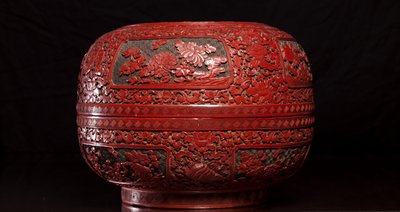
Of all the decorative arts practised in imperial China, none demanded greater patience than the production of carved cinnabar lacquer. The creation of a single piece — a box, a tray, a screen — could require months or even years of painstaking labour: the application of hundreds of gossamer-thin coats of lacquer, each allowed to harden before the next was laid, followed by the carving of intricate designs through the accumulated layers with blades of exceptional sharpness. The result was an art form of extraordinary depth — both literally, in the three-dimensional relief of its carved surfaces, and figuratively, in the richness of its cultural associations. Qing Dynasty cinnabar lacquerware, with its intricate floral panels of chrysanthemums and peonies in deep relief, represents the culmination of a tradition stretching back nearly a millennium.
Origins: From Song Innovation to Imperial Luxury
The art of carving lacquer — diaoqi (雕漆) in Chinese — emerged during the latter years of the Song Dynasty (960–1279), though literary sources suggest antecedents in the late Tang. The lacquer itself is the sap of the Toxicodendron vernicifluum tree, native to southern China, which possesses the remarkable property of hardening to a durable, lustrous finish when exposed to oxygen and humidity. This natural resin had been employed as a protective and decorative coating since the Neolithic period, but the technique of building up thick coats for subsequent carving was a Song-dynasty innovation of considerable ambition.
The earliest surviving carved lacquer pieces, many of which are preserved in Japanese temple collections — notably the important group at the Engaku-ji in Kamakura — display the abstract geometric patterns known as guri or "Sword-Pommel" designs. These pieces, with their interlocking scrolls carved through alternating layers of red, black, and sometimes yellow lacquer, reveal the "marbled" cross-section that is one of the hallmarks of the medium.
By the Yuan and Ming Dynasties, the decorative repertoire had expanded dramatically to include figures in landscapes, birds amid flowering branches, and the dense floral compositions that would reach their fullest expression under the Qing. The Ming Dynasty, in particular, saw carved lacquer elevated to a position of imperial prestige, with the court workshops producing pieces of extraordinary technical refinement.
The Technique: Patience as Medium
The production of carved cinnabar lacquer is a process that admits no shortcuts. The base object — typically turned from wood, though bamboo and fabric-covered cores were also employed — was first prepared with layers of fabric and lacquer paste to create a smooth, dimensionally stable foundation. Onto this base, the artisan applied thin coats of lacquer tinted vermillion with powdered cinnabar (mercury sulphide), the mineral that gives the medium its name and its distinctive deep red colour.
Each coat was allowed to dry — a process that, counterintuitively, requires humidity rather than aridity, as lacquer cures through a biochemical reaction catalysed by moisture. The thickness of individual coats was critical: too thick, and the lacquer would crack or wrinkle; too thin, and the build-up to carvable depth would require an impractical number of applications. Period and modern sources agree that a typical piece might require between one hundred and three hundred individual coats to achieve the necessary depth, with the total thickness of the lacquer reaching approximately three millimetres.
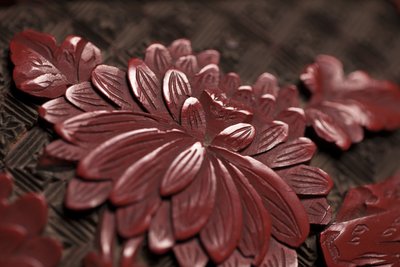
Only when the accumulated layers had reached sufficient depth — and had cured to the proper consistency, firm enough to hold a sharp edge yet soft enough to be carved without chipping — did the carving begin. Using finely honed blades, the craftsman cut into the lacquer surface to create designs in deep relief, a process that has been compared to sculpture in its irreversibility: as with marble, what was removed could not be restored. The finest carvers achieved effects of remarkable delicacy, rendering individual petals, stamens, and leaf veins with a precision that belied the difficulty of working in so unforgiving a medium.
Chrysanthemums and Peonies: The Language of Flowers
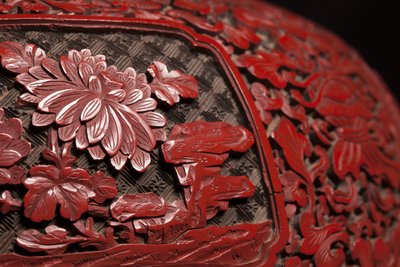
The floral panels that distinguish Qing Dynasty cinnabar lacquerware are composed in the symbolic vocabulary that pervades all Chinese decorative art. The chrysanthemum (ju, 菊), associated with the ninth month and with the scholar's virtue of integrity, was among the most frequently depicted flowers in the medium. Its radial form — a central disk surrounded by tightly packed petals — was ideally suited to the carving technique, allowing the artisan to demonstrate virtuosity in the articulation of individual petals at varying depths.
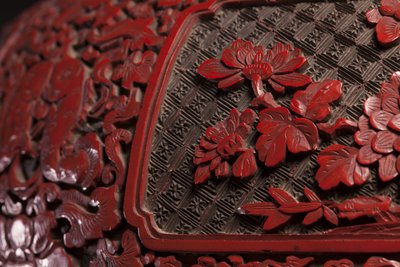
The peony (mudan, 牡丹), by contrast, symbolised wealth, honour, and the beauty of the feminine. Known as the "king of flowers," the peony appears in cinnabar lacquer in compositions of considerable complexity, its layered, ruffled petals demanding a carving skill of the highest order. The combination of chrysanthemum and peony — autumn and spring, scholarly integrity and material prosperity — created a decorative programme of complementary significance.
These flowers are typically set within panels framed by geometric borders, key-fret patterns, or lotus-petal lappets, creating a structured composition that balances the organic exuberance of the floral motifs against the discipline of the framing device. On the finest pieces, the background behind the flowers is carved with a fine diaper pattern — a dense, low-relief texture that serves both to enhance the three-dimensional effect of the main design and to demonstrate the carver's mastery of his medium.
The Qing Achievement
Under the Qing Dynasty, and particularly during the reign of the Qianlong Emperor (1736–1795), carved cinnabar lacquer reached new heights of elaboration and technical sophistication. Colours became brighter and the relief deeper than in Ming predecessors. Lines grew finer, patterns more intricate, and the range of objects expanded to include large-scale furniture, architectural screens, and ritual vessels alongside the traditional repertoire of boxes, trays, and scholar's desk accessories. This same period witnessed equally remarkable achievements in other imperial media, from imperial yellow ground porcelain to carved jade carvings, all reflecting the Qianlong Emperor's extraordinary patronage of the decorative arts.
The imperial workshops in Beijing — distinct from the provincial lacquer centres — produced pieces of almost unimaginable intricacy, some incorporating multiple colours of lacquer carved to reveal contrasting layers. The quality of production declined following the death of the Qianlong Emperor, as the political and economic crises of the nineteenth century drained the resources available for luxury production. Nevertheless, Qing Dynasty cinnabar lacquer of the eighteenth and nineteenth centuries remains the standard against which all subsequent production is measured.
Collecting Carved Cinnabar Lacquer
The assessment of cinnabar lacquer requires attention to several diagnostic criteria. The depth and crispness of the carving is paramount: on genuine period pieces, the cut surfaces should display clean, sharp edges and smooth walls, evidence of work executed in properly cured lacquer by a skilled hand. Soft, rounded edges or rough, fibrous cut surfaces may indicate either improper curing or later, less accomplished production.
The colour of the lacquer itself is revealing. Authentic cinnabar lacquer, coloured with mercury sulphide, displays a warm, slightly translucent red that is distinct from the flatter, more opaque reds produced by modern synthetic pigments. Over time, genuine cinnabar lacquer acquires a patina — a subtle darkening and mellowing of the surface — that is difficult to replicate artificially. The colour should be consistent throughout the depth of the carving; variations in tone between the surface and the depths of the cuts may indicate multi-period repairs or composite construction.
The base of the object — its interior and underside — should be examined for evidence of the cloth and paste foundation typical of period production, and for the wear patterns consistent with centuries of use. The sensitivity of lacquer to light, which can cause fading and cracking, means that well-preserved examples are particularly prized.